Flipped learning sounds simple: pupils encounter new material before the lesson, then use classroom time to apply it. In practice, the difference between a useful flipped-learning routine and "watch this video for homework" is all in the design.
My aim is not to move teaching out of the classroom. It is to move the right parts of learning out of the classroom. If pupils can establish core terminology, definitions, straightforward relationships and basic ideas independently, I can use lesson time for the work that benefits most from having a teacher present: questioning, modelling, practical work, feedback, difficult calculations and deeper reasoning.
Guided notes have become central to that approach. More recently, I have also used AI to tackle one of the biggest barriers to doing this consistently: the administrative workload involved in creating, checking and maintaining the resources.
The useful question is not "What can I put online before the lesson?" but "What can pupils reasonably learn independently so that classroom time can be used for the things that benefit most from having a teacher there?"
What I mean by flipped learning
A flipped model changes the sequence of learning rather than simply adding more homework. Before the lesson, pupils encounter carefully selected introductory material. During the lesson, the teacher builds on that first encounter through explanation, questioning, application and feedback.
For example, before an A-level Physics lesson I might expect pupils to learn what amplitude, frequency and time period mean, become familiar with the relevant symbols and units and use a straightforward relationship such as f = 1/T. I would not necessarily expect them to develop a difficult derivation or tackle a demanding multi-stage problem alone. Those are better reserved for the classroom.
The same principle transfers readily across subjects. In History, pre-learning might establish chronology, key people and vocabulary before pupils analyse sources in class. In Biology, pupils might meet structures and terminology before applying them to unfamiliar processes. In Languages, pupils might learn core vocabulary or grammatical forms before using them in extended speaking and writing.
Why flipped learning can benefit pupils
The evidence base is encouraging, but it also suggests that the benefit comes from how flipped learning is implemented rather than from the label itself.
A large meta-analysis of 198 studies involving 33,678 students found a moderate positive effect on student performance. The authors argued that the main benefit appeared to come from the opportunity for more structured active learning and problem-solving during class.1
That finding needs some caution in a school context, because most of the studies in the meta-analysis were conducted in higher education, with a much smaller number at secondary and primary level.
In the UK, an Education Endowment Foundation trial of a flipped-learning maths programme found a small positive impact in primary mathematics, equivalent to around one additional month of progress. Teachers particularly valued having information about pupil understanding before pupils entered the classroom, although some also reported additional preparation time.2
Those findings fit closely with what I want from the approach. I want pupils to arrive with an initial mental framework already in place. They should have encountered the language of the topic, met its important quantities or concepts and started to think about what those ideas mean. That changes the starting point of the lesson.
The problem with "watch this video"
Simply giving pupils a video link does not guarantee useful pre-learning. A pupil can play a ten-minute video while doing something else and technically complete the homework. At the other extreme, asking pupils to "watch the video and make notes" can turn into transcription, with pupils repeatedly pausing the video to copy sentences without deciding what matters.
Neither approach creates much active processing. This is where guided notes become useful.
What are guided notes?
Guided notes provide the structure of the learning while requiring pupils to complete selected parts of it. Most explanatory information that pupils gain little from copying is already written for them. Pupils instead record the information or thinking that is worth doing themselves. That might mean asking pupils to:
- complete important parts of definitions, equations, symbols or units
- label diagrams or complete partially drawn graphs
- finish a worked example or calculation
- predict an outcome before continuing
- compare two ideas or explain a relationship in their own words
- answer short retrieval and application questions.
The aim is not to create an enormous cloze worksheet. If every task is simply filling in one missing word, pupils can often complete the resource without thinking very hard. The notes should reduce unnecessary writing while preserving necessary thinking.
There is also a longer-term benefit: once completed, the guided notes should still make sense as a revision resource. Pupils are not producing disposable homework; they are gradually building a coherent set of course notes.
What this looks like in practice
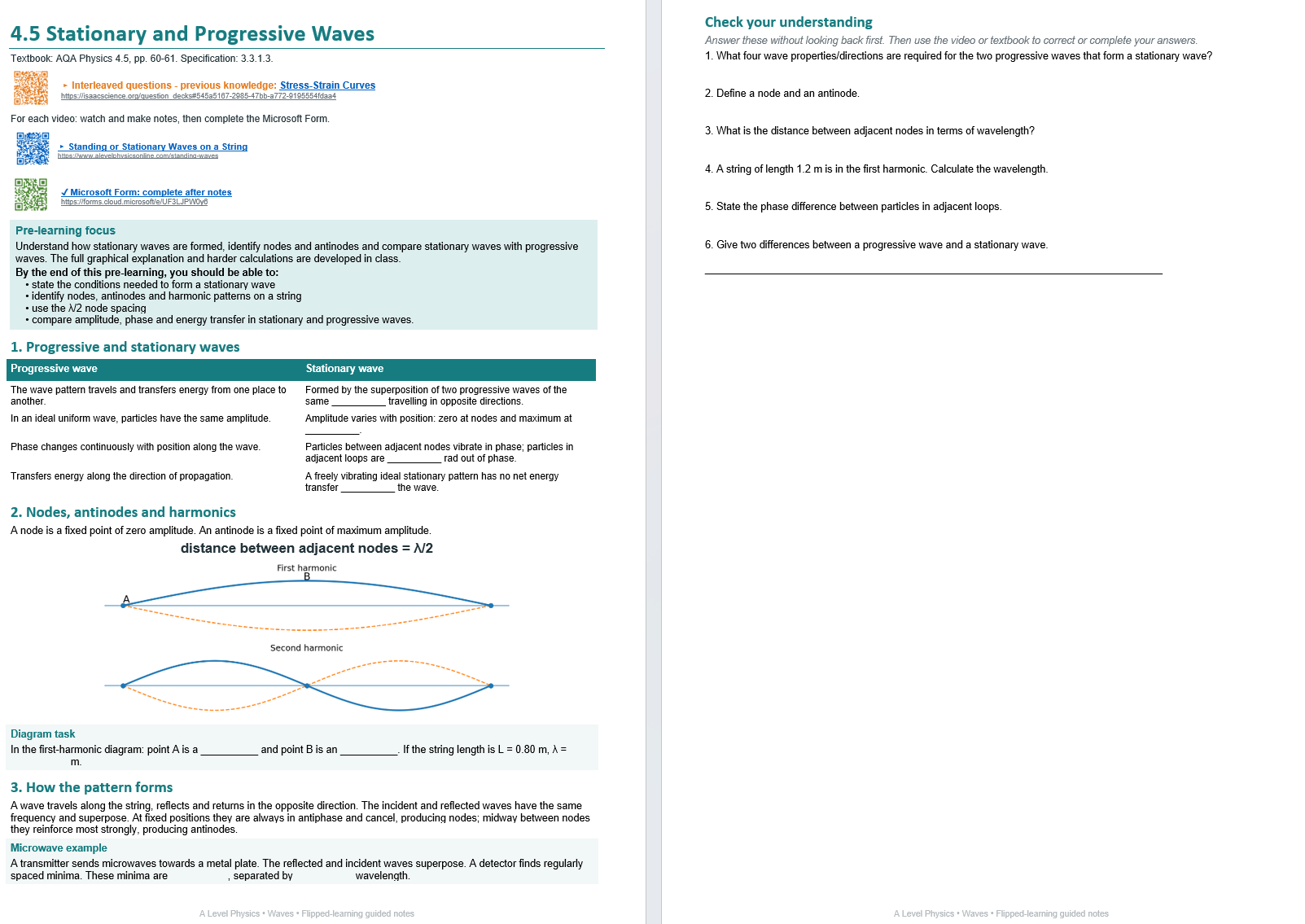
One of my Physics resources introduces oscillations. The first page contains the relevant textbook reference, an interleaved retrieval activity based on previous learning, links to the pre-learning videos and the short online check completed afterwards. It then gives pupils a clear pre-learning focus.
The pupil is not asked to copy paragraphs defining every term. Instead, the explanation is supplied and pupils complete meaningful elements such as the definition of equilibrium position, displacement and amplitude. They then complete the sequence of positions during an oscillation, distinguish free and damped motion and work with period, frequency and angular frequency.
How pupils use the flipped-learning routine
My current routine has four connected stages. The exact platforms are not important; each can be replaced by an equivalent that suits the subject or school.
1. Retrieve something from previous learning
I often begin with an interleaved activity from earlier material. In Physics I use Isaac Physics, but the principle is subject-neutral. A Maths department might use Dr Frost or another question platform. A Languages department might use Quizlet or a vocabulary system. A teacher could equally use a printed retrieval task. The important feature is deliberate recall of previous learning rather than allowing homework to become entirely topic-by-topic.
2. Work through new material using guided notes
Pupils watch the selected video, read the chosen material or use another appropriate source while completing the guided notes. The notes broadly follow the sequence of the source so pupils do not have to search backwards and forwards. At appropriate points I use prompts such as "Pause the video and attempt this before continuing" so pupils make a genuine attempt before immediately seeing the explanation.
3. Complete a short low-stakes check
At the end, pupils complete a short online quiz. I currently use an eight-question Microsoft Forms quiz, but this could just as easily be Google Forms, Moodle, Canvas or another platform. The quiz serves two purposes: it gives pupils an opportunity to retrieve the new material and it gives me information about what they understood before the lesson begins.
4. Use the lesson to develop the ideas
The subsequent lesson should not simply repeat the pre-learning. It should build on it. That might involve a more difficult graph, practical work, an extended explanation, a derivation, a multi-stage calculation, source evaluation or misconceptions exposed by the pre-learning quiz. This is where I think the main value of flipping occurs.
This use of quizzes also aligns with the EEF's wider advice on retrieval practice: retrieval is most useful when teachers are clear about what knowledge is being recalled, why it matters and how the information will be used.3
Flipped learning is not a substitute for teaching
There is an obvious risk with flipped learning: it can become a mechanism for transferring responsibility for teaching new material from the teacher to the pupil. That is not the approach I am advocating.
The pre-learning is a first encounter with carefully selected material. The classroom remains the place where understanding is developed, misconceptions are diagnosed, difficult thinking is supported and pupils receive feedback.
The teacher workload problem
This was one of the biggest barriers I encountered. A single good flipped-learning lesson may require a teacher to identify suitable pre-learning content, check it against the specification, locate corresponding textbook material, select a video or reading, create guided notes, prepare an answer version, build a quiz, create links and QR codes and then check that all of those resources actually align.
Doing that once is manageable. Doing it for an entire course is a substantial administrative task. This is the part of the process where I have found AI particularly useful.
How I use AI without outsourcing the pedagogy
I do not ask an AI system to decide what my pupils should learn and generate a worksheet from its own general knowledge. Instead, I give it the sources that should control the resource and a clear workflow describing how those sources should be used.
For my AQA Physics resources, the exam specification is the definitive source for examinable scope. Lesson PowerPoints help identify what I intend to teach in class. Video transcripts provide the sequence of the pre-learning. The textbook is used to verify terminology, equations and appropriate depth. Separate reference documents define how the guided notes, quizzes and Word files should be structured.
The AI then performs much of the repetitive work required to bring those sources together, while the pedagogical boundaries are defined in advance.
What the AI workflow does
- maps each lesson to the relevant specification section, textbook pages and pre-learning source
- identifies content suitable for independent pre-learning and content that should remain for classroom teaching
- creates the short pre-learning quiz from the same agreed scope
- generates the pupil guided notes from the original teaching sources
- creates a separate Teacher Answer Guide with answers to every gap, task and calculation
- checks links, QR codes, equations, tables, page breaks and document layout before the files are delivered.
That last stage is deliberately mundane. It is also exactly the type of work automation can handle well. I would rather spend my time deciding what pupils need to learn and responding to their misconceptions than manually checking whether a QR code has moved outside a table cell.
AI has changed the scalability, not the pedagogy
The most important lesson for me is that AI has not fundamentally changed what I think good flipped learning looks like. It has changed whether I can realistically produce the supporting resources at scale.
I still decide what happens before the lesson and what happens during it. I still choose the video, reading or explanation. I still decide whether a relationship belongs in the pre-learning or whether its derivation belongs in class. What AI can do is repeatedly apply those decisions across many lessons and handle the formatting, checking and file production.
Once the workflow is defined, resource creation becomes less about rebuilding documents from scratch and more about checking, refining and approving what has been generated. That is a much better use of teacher time.
Building a repeatable workflow
I have moved away from writing a new AI prompt for every lesson. Instead, I have built the process into a ChatGPT Project with permanent instructions and reusable reference files. I can then begin a new chapter with a simple command such as "START NEW GUIDED-NOTE PACK: Materials", and the system takes me through the required stages in order.
This makes the process repeatable and, importantly, shareable. Another teacher can use the same framework while replacing my Physics-specific sources with their own specification, textbook, lesson materials and subject-specific platforms.
The approach is not Physics-specific
My implementation happens to use an AQA Physics specification, a Physics textbook, lesson PowerPoints, Physics videos, Isaac Physics and Microsoft Forms. None of those individual services is essential to the model.
A department could instead use its own exam-board specification, departmental textbook or reading, lesson resources, a subject-specific retrieval platform and Google Forms. A teacher might not use video at all. English Literature pre-learning might involve contextual reading; Geography might use a case-study resource; Computer Science might use a demonstration with partially completed code; History might establish chronology before source evaluation.
Decide which knowledge pupils can meaningfully establish independently, then protect classroom time for the learning that benefits most from expert teaching, discussion and feedback.
Watch the workflow
This screen recording walks through the process end to end: setting up the project, starting a new guided-note pack, working through the stages and checking the generated pupil notes, teacher answer guide and quiz.
Want to try the workflow yourself?
I have packaged the workflow in two forms so that other educators can inspect it, use it and adapt it.
This version mirrors my own AQA A-level Physics workflow as closely as possible. It is intended for teachers who want to see the complete system working with the same structure I use.
AQA_Guided_Notes_READY_TO_GO_v1.0.zip · ~85 MB Download packThis version is designed for other exam boards and subjects. Teachers upload their own specification, textbook or reference sources and can replace the quiz platform, retrieval platform, file structure or guided-notes design to suit their context.
Guided_Notes_CUSTOMISABLE_Any_Exam_Board_v1.0.zip · ~200 KB Download packIf you are starting with flipped learning
I would start small. Choose one topic where there is a clear body of introductory material that pupils can reasonably access independently. Decide carefully what you do not want them to learn alone. Create one guided-notes resource and one short check of understanding, then look closely at what happens in the next lesson.
Questions to ask after that first lesson
- Did pupils arrive better prepared?
- Were you able to begin the lesson at a more useful point?
- Did the pre-learning expose misconceptions you could respond to?
- Did you spend more classroom time on worthwhile thinking?
- Was the homework manageable for pupils and sustainable for you?
Those questions matter more than whether the lesson technically fits somebody else's definition of a flipped classroom.
Flip the right things
I do not think the goal should be to remove explanation from lessons. There are explanations I deliberately want to give myself, questions where I want to see pupils' first responses and difficult ideas where responsive questioning and modelling are central to the teaching.
But there are also parts of a curriculum where pupils can productively establish some foundational knowledge before arriving in the classroom. Guided notes can make that independent learning active rather than passive. A short online check can provide useful feedback. AI can make the resource production manageable enough to sustain the approach across a course.
For me, the technology is useful because it supports a pedagogical decision, not because it replaces one.
Use independent learning for the material pupils can reasonably access independently, so that precious classroom time can be spent on the learning that benefits most from having a teacher there.
References and further reading
- Strelan, P., Osborn, A. and Palmer, E. (2020), 'The flipped classroom: A meta-analysis of effects on student performance across disciplines and education levels', Educational Research Review, 30, 100314. DOI.
- Education Endowment Foundation, Flipped Learning project and evaluation report.
- Education Endowment Foundation, 'Why bother with retrieval practice?' and wider guidance on retrieval practice.