Teachers are surrounded by advice about learning. Retrieval practice, cognitive load, feedback, metacognition, active learning, spacing and deliberate practice all compete for attention.
Taken separately, these ideas can feel like a collection of techniques: a list of things to try, squeezed into lessons one at a time.
Considered together, they point towards something much more coherent. They are not twelve strategies. They are twelve parts of the same process.
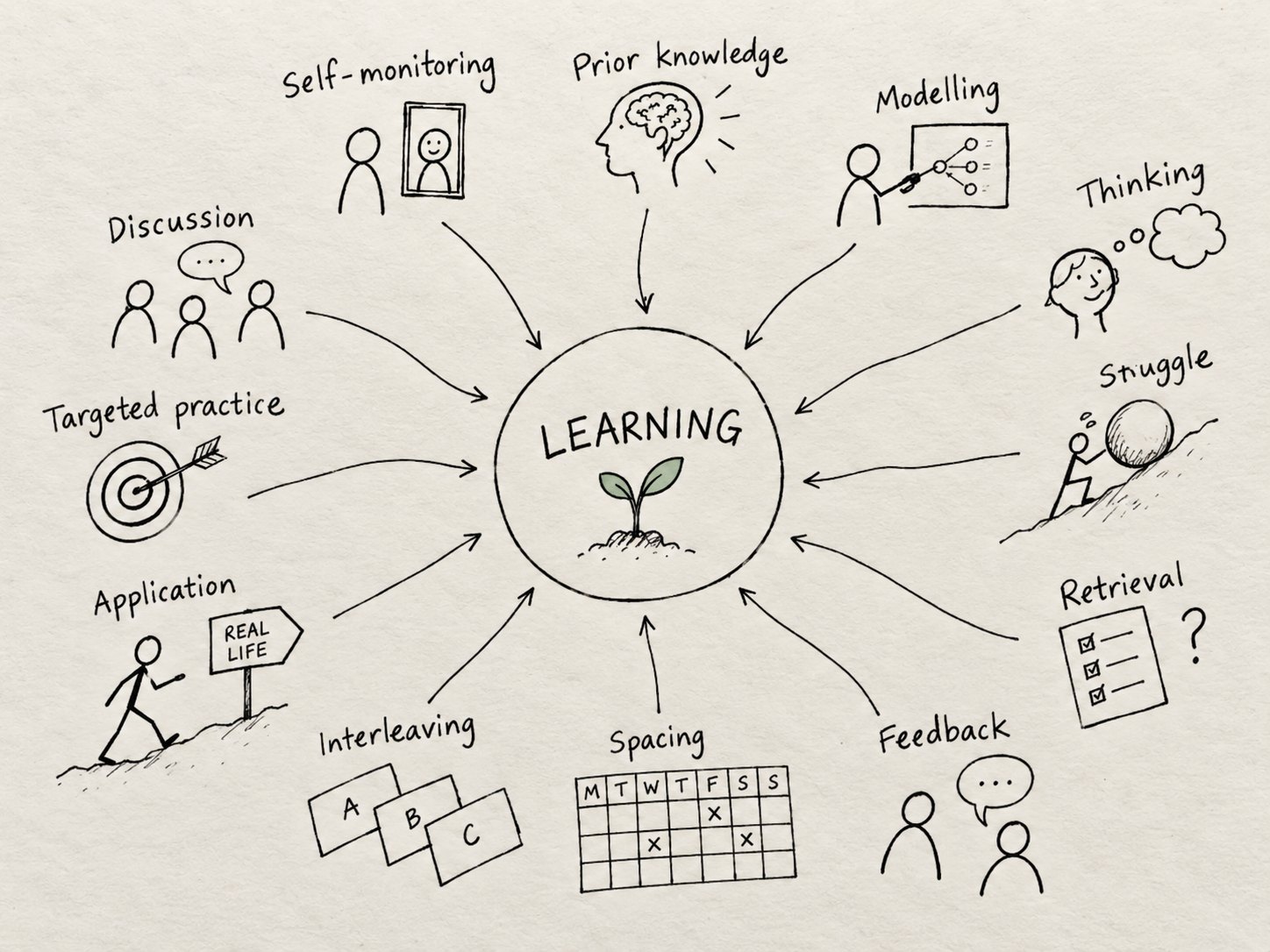
Across the sources reviewed here, the central message is consistent. Durable learning depends less on how much information pupils encounter and more on what they are required to do with it.
Learning becomes more robust when pupils connect new knowledge to what they already know, retrieve it, attempt to use it, receive useful feedback, correct errors and encounter it again after time has passed.
There is also an important distinction between performance and learning. A pupil can follow an explanation, complete a scaffolded task or recognise the correct answer and still be unable to reproduce the thinking independently later.
The twelve principles below are therefore best understood as a framework for designing learning across time, rather than a checklist for a single lesson.
A note on the evidence
This article combines peer-reviewed research with practitioner books and theoretical works. The strongest claims are anchored in systematic reviews, meta-analyses and classroom studies.
Practitioner sources such as Thom (2018) and Young (2019) are used mainly to frame or translate research into practice, while Mercier and Sperber (2017) provide a theoretical account of reasoning rather than a classroom intervention study.
1. Build on prior knowledge
New learning is interpreted through what a pupil already knows. As knowledge becomes better organised in long-term memory, learners can recognise patterns, connect ideas and solve problems more efficiently.
Research on expertise describes this in terms of increasingly sophisticated domain-specific mental representations, rather than a general ability to think hard about anything (Ericsson, Krampe and Tesch-Römer, 1993).
That makes prior knowledge a practical teaching issue rather than an abstract one. Before teaching electromagnetic induction, for example, pupils need sufficiently secure ideas about magnetic fields, current and forces for the new concept to have something to connect to.
Thom's emphasis on planning for learning over time makes a similar point: curriculum sequencing should identify prerequisite knowledge and deliberately connect new material with what came before (Thom, 2018).
Teaching implication: activate relevant prior knowledge, diagnose important gaps and make the links between old and new ideas explicit.
2. Explain and model clearly before expecting independence
Active learning does not mean that teachers should stop explaining.
Novices often need accurate explanations, worked examples and modelling before they can perform successfully on their own. For unfamiliar procedures and principles, worked examples can initially support learning more effectively than asking pupils to reconstruct a method they have not yet formed (Yeo and Fazio, 2019).
Good modelling should reveal the decisions that experts make but novices cannot yet see. In physics, that means explaining not only which equation is used, but why it applies, which information matters and how we know whether an answer is physically reasonable.
Thom (2018) similarly argues for live modelling of both the product and the thinking behind it, followed by a gradual transition towards independent practice.
Teaching implication: use explanation and modelling to build an accurate representation, then fade support so that pupils eventually make the decisions themselves.
3. Make pupils cognitively active
Visible activity is not the same as cognitive activity.
A pupil can spend a practical lesson manipulating apparatus while thinking mainly about following instructions. Conversely, a pupil watching a demonstration can be thinking deeply if they have predicted what will happen, committed to an explanation and then have to reconcile that explanation with the result.
Smith and Holmes analyse this problem in physics teaching. Their comparison of verification laboratories, traditional demonstrations and enhanced demonstrations highlights the importance of prediction, cognitive load and engagement.
Their argument is not that practical work is ineffective, but that hands-on activity does not automatically produce conceptual learning. Enhanced demonstrations can focus attention on the physics by requiring students to predict, observe and explain (Smith and Holmes, 2017).
Teaching implication: when planning an activity, ask not only 'What will pupils do?' but 'What will they have to think about?'
4. Preserve productive struggle
Good learning often feels harder than poor learning.
Rereading notes feels fluent. Watching somebody else solve a problem can feel reassuring. Retrieval and independent problem solving are usually more effortful, which can make them feel less successful even when they produce stronger later learning.
Difficulty, however, is only useful when it is tied to the learning goal. Retrieval studies suggest that more effortful successful retrieval can strengthen later memory, but failure without adequate support can undermine the benefit (Pyc and Rawson, 2009).
Similarly, complex tasks can overload a novice if they are asked to solve a problem before they possess an adequate representation or procedure (Yeo and Fazio, 2019).
The practical distinction is therefore between productive difficulty and unnecessary difficulty.
Keep the difficulty
- Retrieving knowledge without notes
- Deciding which method applies
- Constructing an explanation
- Committing to a prediction
- Finding and correcting an error
Remove the difficulty
- Confusing instructions
- Cluttered or unclear resources
- Mechanical copying
- Avoidable technical problems
- Task complexity irrelevant to the goal
Teaching implication: remove confusing instructions and irrelevant load, but do not remove the thinking, retrieval or decision making that the learning goal requires.
5. Retrieve rather than simply revisit
Retrieval practice is one of the most robust findings in this collection. Attempting to retrieve previously learned material generally produces better delayed retention than simply restudying it (Roediger and Karpicke, 2006; Agarwal, Nunes and Blunt, 2021).
A large classroom meta-analysis also found a positive overall effect of quizzing across educational settings (Yang et al., 2021).
This changes the role of testing.
A quiz can measure learning. The act of retrieval can also create it.
That provides a rationale for low-stakes questioning, mini-whiteboards, cumulative quizzes, closed-book recall and self-testing.
Retrieval should also match the eventual goal. If pupils need to explain, calculate, discriminate or apply, they should retrieve and coordinate the knowledge required for those actions, not only memorise isolated facts.
Teaching implication: build frequent low-stakes retrieval into normal teaching, and retrieve relationships, explanations and strategies as well as facts.
6. Give corrective feedback and require repair
Retrieval is especially valuable when errors lead somewhere.
Classroom research shows that corrective feedback strengthens the benefits of testing, particularly when a pupil's first attempt is unsuccessful (McDermott et al., 2014; Yang et al., 2021). A broader meta-analysis also found that feedback has a positive average effect, although its impact varies substantially according to the task, learner and form of feedback (Wisniewski, Zierer and Hattie, 2020).
The implication is that feedback should not finish with the teacher. A mark, tick or written comment has limited value if pupils never use it.
The more useful cycle is attempt, feedback, correction and reattempt. For an incorrect response, pupils need enough information to identify the error and another opportunity to demonstrate that the underlying thinking has changed.
Teaching implication: judge feedback by what pupils do next, not by how much the teacher writes.
7. Space learning over time
Immediate performance can be misleading. When pupils practise something repeatedly in a short period, they may appear fluent because the material is still highly accessible.
Durable learning requires returning to knowledge after some forgetting has occurred.
Spacing is supported by a large evidence base. Cepeda et al. (2006) found a robust advantage for distributed over massed practice, while a later meta-analysis specifically examining spaced retrieval also found benefits for retention (Latimier, Peyre and Ramus, 2021).
There is no single universal interval that schools should copy, but the principle is clear: important knowledge should recur across lessons, weeks and terms.
Teaching implication: if knowledge matters, plan for it to return. Starters, homework, quizzes and later assessments should deliberately sample older material.
8. Interleave once pupils have a foundation
Practice can make a task easier by giving away the strategy.
A worksheet containing fifteen consecutive momentum questions tells pupils, before they have read the first problem, which area of physics they are expected to use. In an examination or unfamiliar situation, that cue disappears.
Interleaving mixes related problem types so pupils must decide which concept or method applies. A meta-analysis found that its effects depend strongly on the material and are most useful where learners need to discriminate between similar categories (Brunmair and Richter, 2019).
Classroom mathematics research has also shown improvements in delayed problem solving from interleaved practice (Rohrer, Dedrick and Stershic, 2015).
Importantly, this should normally follow initial instruction and some supported practice rather than replacing them.
Teaching implication: teach a method clearly first, then mix it with plausible alternatives so that pupils practise choosing as well as executing.
9. Practise what pupils ultimately need to do
Transfer is difficult. Knowledge learned in one context does not automatically appear when the surface features change.
Young (2019) calls the practical response 'directness': increasingly practise the thing you ultimately want to become good at.
The research base supports the broader point that transfer is more likely when practice requires learners to retrieve and apply knowledge across varied examples.
Butler et al. (2017) found that retrieving and applying knowledge to different examples promoted transfer, while Pan and Rickard's meta-analysis found a positive transfer effect overall but weaker effects as the final task became less similar to the practice task (Pan and Rickard, 2018).
Teaching implication: if pupils need to solve unfamiliar problems, construct arguments or perform practical skills independently, those performances must eventually become part of the practice.
10. Diagnose weaknesses and practise them deliberately
Practice is not automatically improvement. Repeating comfortable questions may increase fluency while leaving the limiting weakness untouched.
Deliberate practice was originally defined as structured activity designed specifically to improve a component of performance, with clear goals, informative feedback and repeated opportunities for refinement (Ericsson, Krampe and Tesch-Römer, 1993).
This idea is useful in schools when it is applied cautiously. A meta-analysis found that measured deliberate practice explained only a modest proportion of variation in performance across domains, so it should not be treated as a complete theory of achievement (Macnamara, Hambrick and Oswald, 2014).
Its practical value is diagnostic. 'Revise electricity' is vague, whereas 'you are confusing current and potential difference in parallel circuits' identifies something that can be practised directly.
Teaching implication: use assessment to identify the specific bottleneck, then design practice around that weakness rather than repeating whole tasks indiscriminately.
11. Make pupils explain, justify and argue
Reasoning is not necessarily best developed in isolation. Mercier and Sperber (2017) argue that a central function of human reasoning is argumentative: producing reasons for others and evaluating the reasons that others give us.
Their account is theoretical rather than a classroom-effect study, but it offers a useful lens for designing discussion.
The educational value of talk therefore depends on its structure. 'Discuss with your partner' is not enough.
Pupils should have to justify a claim, compare explanations, identify where an argument fails or respond to a counterexample. In physics, prompts such as 'Which solution is more convincing and why?' or 'Convince your partner that the current must be the same at these two points' make the reasoning itself visible.
Teaching implication: use peer discussion when it requires pupils to produce, evaluate and revise reasons, not simply exchange answers.
12. Teach pupils to monitor their own learning
Learners are often poor judges of what they know.
Familiar material can feel learned because it is easy to process, while successful recognition can be mistaken for the ability to recall or apply something independently.
Reviews of learning techniques repeatedly warn that rereading and highlighting can create misleading feelings of fluency, whereas self-testing gives learners more diagnostic information about what they can actually retrieve (Dunlosky et al., 2013).
Metacognition therefore needs to be concrete. Pupils should ask:
- Can I explain this without my notes?
- Can I solve a similar problem without the worked example?
- Can I still retrieve it next week?
- Where exactly does my reasoning break down?
Thom (2018) makes a similar case for explicitly teaching pupils to plan, monitor and evaluate their work rather than assuming that self-regulation develops automatically.
Teaching implication: give pupils regular opportunities to test themselves without support and to identify precisely what they can and cannot yet do.
Bringing the twelve principles together
These are not twelve independent strategies. They describe different parts of the same learning process.
A well-designed sequence might retrieve relevant prior knowledge, explain and model something new, ask pupils to attempt it and expose their thinking, then use feedback to correct errors.
The knowledge returns later through spaced retrieval, becomes mixed with related ideas and is eventually applied in unfamiliar contexts with less support.
The balance changes as expertise develops. Early learning may involve more explanation, modelling and blocked practice. Later learning should increasingly require retrieval, discrimination, independent problem solving, transfer and self-monitoring.
This is why the framework is better understood across a unit or a curriculum than as a requirement to fit all twelve elements into every lesson.
A useful question for planning
Perhaps the most useful thread running through all twelve principles is that visible activity is a poor substitute for thinking.
More slides, more worksheets, more marking, more technology or more assessment do not automatically produce more learning. The practical question is simpler:
What thinking is this activity requiring pupils to do?
If pupils are mainly copying, recognising, watching or following instructions, the activity may produce smooth performance without much durable learning.
If they are retrieving, predicting, explaining, correcting, choosing, applying and revisiting knowledge, the chances of durable learning are much stronger.
Conclusion
Across cognitive psychology, classroom research, physics education and the literature on expertise, a coherent message emerges. Learning is a change in what a pupil can retrieve, understand and do independently in the future.
Good teaching therefore builds on prior knowledge, explains and models clearly, makes pupils think, uses retrieval and feedback intelligently, revisits important knowledge over time and gradually transfers responsibility from teacher to pupil.
The value of the twelve principles is not that they provide a formula for perfect lessons. Their value is that they help us distinguish activities that look productive from those that are likely to change long-term knowledge and capability.
The central task of teaching is not simply to make information available. It is to create the conditions in which pupils have to think with it.
Try it on one sequence
Pick a single unit you are about to teach and map it against the chain above. Where does prior knowledge get activated? Where does retrieval return? Where does the scaffolding actually come off?
If this is useful, the companion piece Who is Doing the Thinking? applies the same test to technology and AI, and Assessment in the Age of AI looks at what our assessments are really measuring.
References
- Agarwal, P.K., Nunes, L.D. and Blunt, J.R. (2021), 'Retrieval practice consistently benefits student learning: A systematic review of applied research in schools and classrooms', Educational Psychology Review, 33, pp. 1409–1453. DOI.
- Brunmair, M. and Richter, T. (2019), 'Similarity matters: A meta-analysis of interleaved learning and its moderators', Psychological Bulletin, 145(11), pp. 1029–1052. DOI.
- Butler, A.C., Black-Maier, A.C., Raley, N.D. and Marsh, E.J. (2017), 'Retrieving and applying knowledge to different examples promotes transfer of learning', Journal of Experimental Psychology: Applied, 23(4), pp. 433–446. DOI.
- Cepeda, N.J., Pashler, H., Vul, E., Wixted, J.T. and Rohrer, D. (2006), 'Distributed practice in verbal recall tasks: A review and quantitative synthesis', Psychological Bulletin, 132(3), pp. 354–380. DOI.
- Dunlosky, J., Rawson, K.A., Marsh, E.J., Nathan, M.J. and Willingham, D.T. (2013), 'Improving students' learning with effective learning techniques: Promising directions from cognitive and educational psychology', Psychological Science in the Public Interest, 14(1), pp. 4–58. DOI.
- Ericsson, K.A., Krampe, R.T. and Tesch-Römer, C. (1993), 'The role of deliberate practice in the acquisition of expert performance', Psychological Review, 100(3), pp. 363–406. DOI.
- Latimier, A., Peyre, H. and Ramus, F. (2021), 'A meta-analytic review of the benefit of spacing out retrieval practice episodes on retention', Educational Psychology Review, 33(3), pp. 959–987. DOI.
- Macnamara, B.N., Hambrick, D.Z. and Oswald, F.L. (2014), 'Deliberate practice and performance in music, games, sports, education, and professions: A meta-analysis', Psychological Science, 25(8), pp. 1608–1618. DOI.
- McDermott, K.B., Agarwal, P.K., D'Antonio, L., Roediger, H.L. III and McDaniel, M.A. (2014), 'Both multiple-choice and short-answer quizzes enhance later exam performance in middle and high school classes', Journal of Experimental Psychology: Applied, 20(1), pp. 3–21. DOI.
- Mercier, H. and Sperber, D. (2017), The Enigma of Reason. Cambridge, MA: Harvard University Press.
- Pan, S.C. and Rickard, T.C. (2018), 'Transfer of test-enhanced learning: Meta-analytic review and synthesis', Psychological Bulletin, 144(7), pp. 710–756. DOI.
- Pyc, M.A. and Rawson, K.A. (2009), 'Testing the retrieval effort hypothesis: Does greater difficulty correctly recalling information lead to higher levels of memory?', Journal of Memory and Language, 60(4), pp. 437–447. DOI.
- Roediger, H.L. III and Karpicke, J.D. (2006), 'Test-enhanced learning: Taking memory tests improves long-term retention', Psychological Science, 17(3), pp. 249–255. DOI.
- Rohrer, D., Dedrick, R.F. and Stershic, S. (2015), 'Interleaved practice improves mathematics learning', Journal of Educational Psychology, 107(3), pp. 900–908. DOI.
- Smith, E.M. and Holmes, N.G. (2017), 'Seeing the real world: Comparing learning from verification labs and traditional or enhanced lecture demonstrations', arXiv preprint arXiv:1712.03174. Preprint.
- Thom, J. (2018), Slow Teaching: On Finding Calm, Clarity and Impact in the Classroom. Woodbridge: John Catt Educational.
- Wisniewski, B., Zierer, K. and Hattie, J. (2020), 'The power of feedback revisited: A meta-analysis of educational feedback research', Frontiers in Psychology, 10, article 3087. DOI.
- Yang, C., Luo, L., Vadillo, M.A., Yu, R. and Shanks, D.R. (2021), 'Testing (quizzing) boosts classroom learning: A systematic and meta-analytic review', Psychological Bulletin, 147(4), pp. 399–435. DOI.
- Yeo, D.J. and Fazio, L.K. (2019), 'The optimal learning strategy depends on learning goals and processes: Retrieval practice versus worked examples', Journal of Educational Psychology, 111(1), pp. 73–90. DOI.
- Young, S.H. (2019), Ultralearning: Master Hard Skills, Outsmart the Competition, and Accelerate Your Career. New York: HarperCollins.
Source note. This article was developed from a teaching and learning source collection, including Assessment as a Learning Process, The Architecture of Mastery, Slow Teaching summaries, Ultralearning notes, The Enigma of Reason material and a physics education summary based on Smith and Holmes. Bibliographic details were checked against the reference lists in those materials. The Smith and Holmes source in the collection labelled the paper as 2019; the manuscript metadata identifies it as a 2017 arXiv preprint, so the reference has been corrected here.